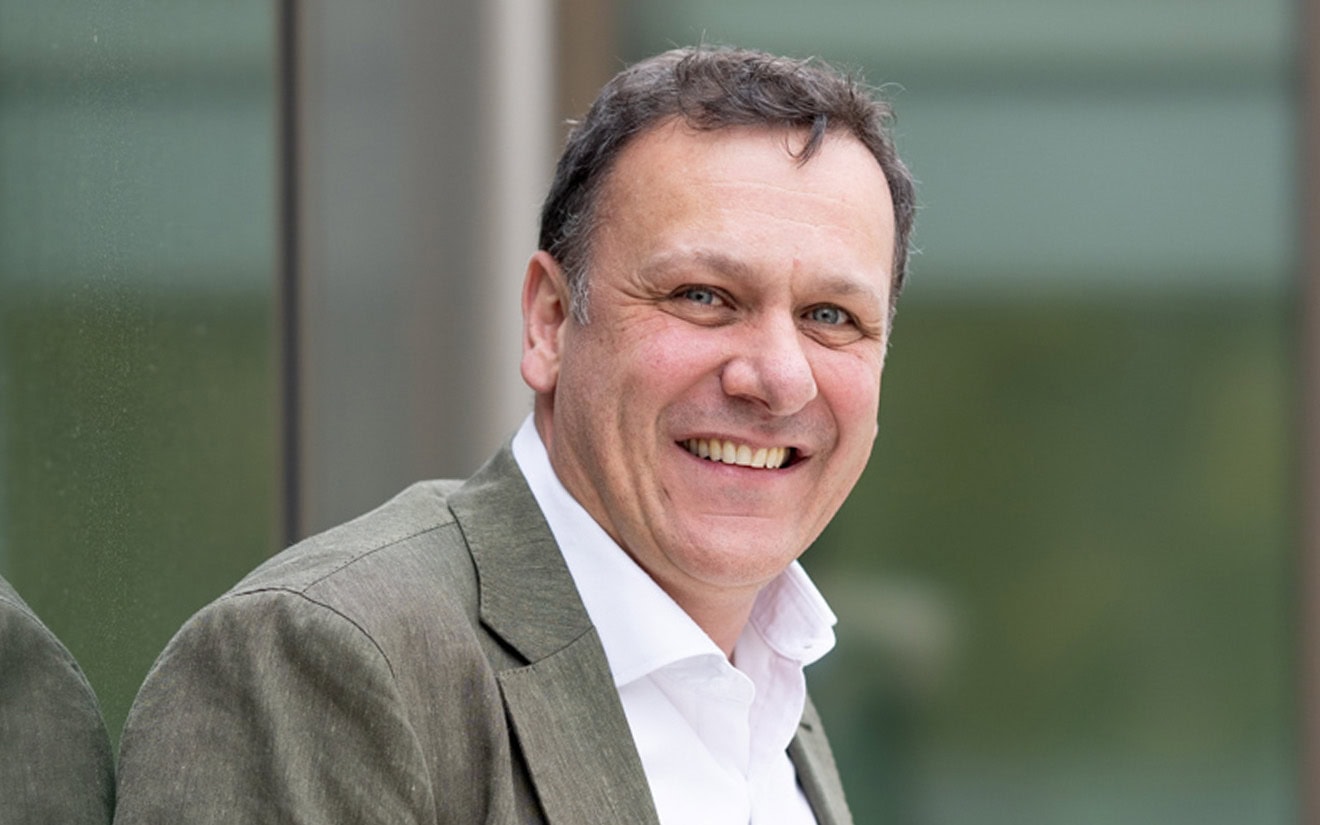

Geopolitical uncertainties, artificial intelligence, inflation - many things are currently being discussed as crucial for the financial markets. For Dominik Nussbaumer, some of this is overestimated. For him, something else is crucial: understanding the interrelationships.
It's not every day that you hear that someone wanted to become a banker at a young age. For our interviewee of the month, this career aspiration is closely linked to early impressions. His first contact was in a family environment: an advisor who didn't sit behind a counter, but came to the family business or home. This was formative for Dominik Nussbaumer: «I was fascinated by this business even back then,» he says looking back. A contrast to today's perception, in which the banking profession is viewed increasingly critically.
What began as an early curiosity developed consistently. After studying law at the University of Basel, he entered banking via a trainee program at a major Swiss bank. This was followed by positions in client advisory services, the investment business and management roles at Basel private banks - culminating in his current role as a partner and member of the Executive Board at Trafina Private Bank AG. This operational responsibility is complemented by his work on boards of directors and foundation boards, where he also deals with strategic and social issues beyond day-to-day business.
What has remained over the years is not just a fascination, but a clear ambition: to understand and classify issues and recognize connections. This is exactly what private banking offers him: «I like to take a broad approach to topics.» It is this systematic penetration of complexity that drives him - unraveling structures, understanding companies and decision-making logic. This way of thinking also shapes his understanding of banking. For Dominik Nussbaumer, it is not a business of short-term trends and quick reactions, but an entrepreneurial task. The roots of Trafina Private Bank AG lie in a family office - and it is precisely this origin that can still be felt today. The focus is on sustainable benefit. Interests are not played off against each other, but are consistently aligned.
«What's good for the customer is also good for us.»
At the same time, the industry is changing noticeably. Technological developments such as AI are gaining in importance, particularly in standardized areas. Processes are becoming more efficient and working models are shifting. For smaller companies in particular, this also increases the requirements - whether in dealing with topics such as IT and cyber security or regulatory requirements.
However, despite this dynamic, Dominik Nussbaumer sees one central constant in private banking: personal interaction. Trust cannot be automated and complex decisions still require a direct contact person.
He also soberly assesses the influence of geopolitical developments. From the perspective of the financial markets, their importance is often overestimated. States act primarily driven by their own interests. Questions of energy supply or economic stability, for example, take precedence over ideological positions. This creates a more challenging environment for smaller countries such as Switzerland.
Whether in an economic or social context, Dominik Nussbaumer believes that personal responsibility is key: «The state cannot guarantee absolute security.» He not only passes on an important lesson he has learned to his son, but also reveals it in this interview.
Mr. Nussbaumer, if you had taken a different path when you were younger, what would you have become?
«This may sound surprising, but I wanted to be a banker from a very young age. And although I worked at the Trafina Private Bank AG I have always been active in various other business areas, I have never lost my passion for banking and have never felt the need to change careers. However, if I hadn't managed to get into banking after my law degree, I would probably have looked for a job in the private sector with a broad range of tasks, where it is important to keep an eye on the overall context of a company, as I was taught to do in our family business from childhood.»
What is your favorite way to start your day?
«I like getting up early, being at the bank early and having a cup of green tea before the sometimes somewhat hectic day-to-day business and taking my time to get to grips with current economic and stock market developments.»
What does success mean to you personally?
«Reliability, commitment, down-to-earthness and integrity are important to me. If I am perceived as a «good» asset manager and boss in these respects, then I have achieved my professional goal. I consider success to be staying true to yourself and consistently pursuing your own goals. Or to put it another way: being yourself and going to bed every night with the attitude that no matter how bad a day may have been, the sun will rise again the next day and life will go on.»
What would you work for free for a week?
«For everything that reflects my personal values and ideals. I like to describe myself as an ultra-liberal capitalist. For me, this goes hand in hand with the responsibility to ensure that our social system is fair and works for the benefit of all, not individuals. In particular, universal, affordable access to good education and the opportunity to achieve personal goals through personal achievement are important to me.»
What was the best professional advice you ever received?
«There was no actual advice. However, I did learn a lesson that I would pass on to my son as advice: ‘If you don't let anyone tell you what you can or can't do and what you should or shouldn't do, you have no choice but to be responsible for what you do with your life’.»
We would like to thank Mr. Nussbaumer for his contribution to this article.
Batterman Consulting Basel AG®
Executive, Expert, and Board of Directors Search
Byfangweg 1a, CH-4051 Basel
T +41 58 680 55 55