Artificial intelligence is increasingly making its way onto the agendas of boards of directors. It is crucial not only to recognize its importance, but also to actively understand and manage its strategic implications for business models, risks, and competitiveness.
I’m not asking this question to be provocative, but rather based on my practical experience. Over the past 24 months, I’ve had dozens of conversations with board chairs, nomination committees, and CEOs. The agenda is always packed, and the challenges are well known: geopolitical uncertainties, a shortage of skilled workers, and regulatory pressure. And yet one topic is increasingly coming to the forefront—often unspoken, sometimes underestimated: artificial intelligence.
The reality is uncomfortable. Many Swiss boards of directors are exceptionally well-staffed, strategically experienced, financially savvy, and internationally connected. But when it comes to AI, there is a gap—not an intellectual one, but an operational one. AI is recognized as important, but rarely truly understood. It is even more rarely actively managed.
The problem begins with how it’s categorized. AI is often delegated as an IT issue to the CIO, the CDO, or external consultants. As a result, it is structurally underestimated. After all, AI is not a tool like any other. It transforms business models, decision-making processes, and value chains. Anyone who reduces it to just technology misses its strategic dimension.
At board meetings, I notice recurring patterns: presentations on „AI initiatives,“ promising roadmaps, and pilot projects in innovation labs. But critical questions are often met with silence. How is AI changing our margin structure? Which of our core competencies will become obsolete? Do we want more revenue or higher quality? Where are new dependencies emerging? And above all: What risks do we bear as a board?
This is where the real challenge lies—not in a lack of knowledge, but in a lack of integration. AI is rarely an integral part of governance. There are no clear responsibilities at the board level, no systematic development of expertise, and no structured decision-making processes. Instead, there is an implicit trust that „management already has it under control.“.
Not every board member needs to be an AI expert. But every board needs at least one member with in-depth, practical AI experience—not theoretical, but operational. Such candidates are currently hard to find. And this is precisely where our role as headhunters begins: systematically scouring the markets for such candidates and recruiting them for board positions.
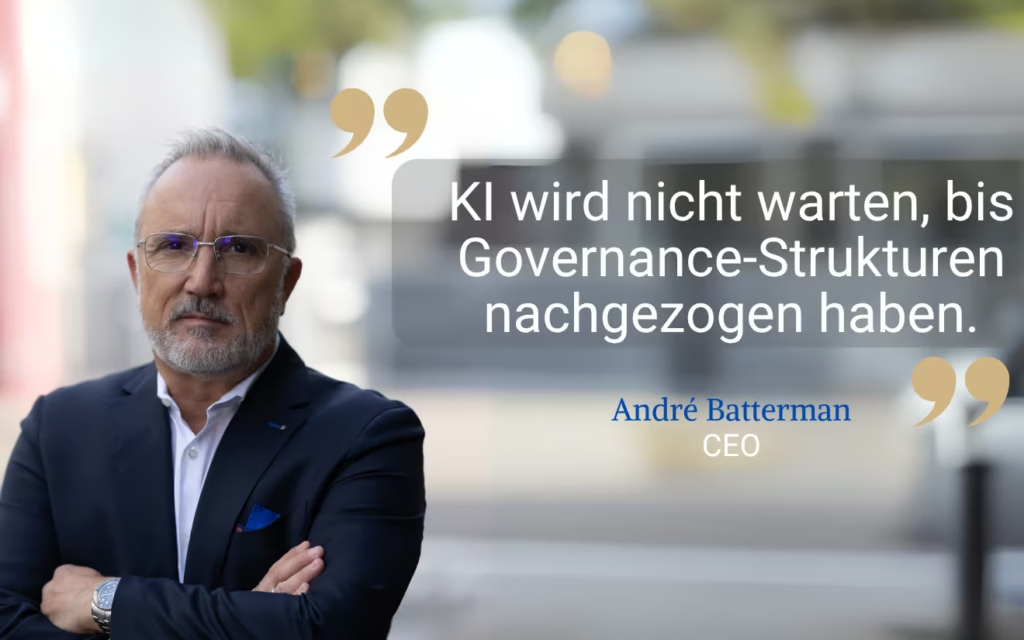
AI won't wait for governance structures to catch up. The question, therefore, is not whether boards of directors are overwhelmed by AI, but whether they are prepared to ensure that they don't remain so.
Batterman Consulting Basel AG®
Executive, Expert, and Board of Directors Search
Byfangweg 1a, CH-4051 Basel
T +41 58 680 55 55